
Ruck Score
One number for any kind of ruck.
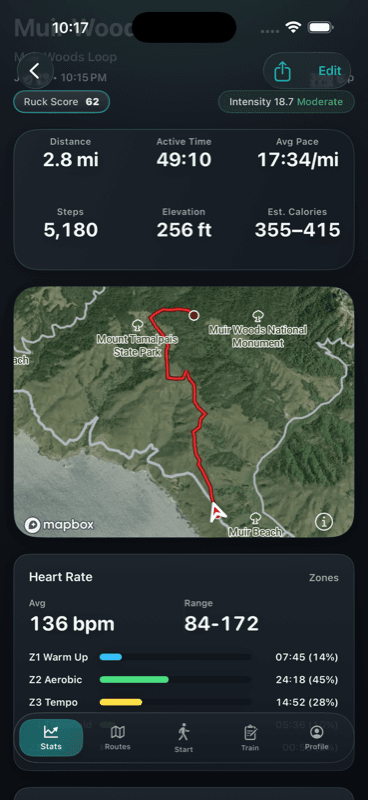
Ruck Score is Ruckly's main training metric. It turns every session into a single, comparable, number. A short heavy ruck and a long light one can easily be measured against each other.
A practical training score, not a step count.
Distance, movement time, body-relative load, terrain, and pace are the biggest drivers. Larger relative load earns stronger credit, so a short heavy ruck can outrank a modestly longer moderate one. Rucks, runs, hikes, and walks can all earn a score when there’s enough data.
It isn’t a simple miles-times-weight total, an exact calorie count, or a precise lab measurement. It’s a single, honest summary you can compare across sessions over time.
What goes into it
The factors behind the number
Distance & movement time
The foundation of every session.
Body-relative load
Pack weight interpreted against your body weight, so 30 lb means different things for different people.
Carry type
Hip pack, vest, or shoulder carry, because the same weight doesn't feel the same.
Pace
Expectations blend from a faster unloaded baseline toward loaded pacing as relative load grows.
Elevation gain
Hillier routes earn a modest lift for the added work.
Consistency
Recent active-day consistency can factor in when enabled.
Ruck Intensity
How demanding the load was, for you.
Ruck Intensity is a load-focused companion to Ruck Score. It's most useful at the start of a session, when you're deciding whether today is light endurance work, a normal training ruck, or a heavier effort.
Light
Easier loaded work.
Moderate
Steady, sustainable loaded work.
Heavy
Meaningfully demanding loaded work.
Strenuous
High-demand work to use selectively.
Questions
Ruck Score FAQ
What affects my Ruck Score?
Why don't I see Ruck Intensity on every workout?
Is Ruck Score the same as calories?
Why does adding body weight matter?
See your own Ruck Score
Download Ruckly, log a session, and watch the number reflect the real work you put in. Free to start, with a 7-day Pro trial.